
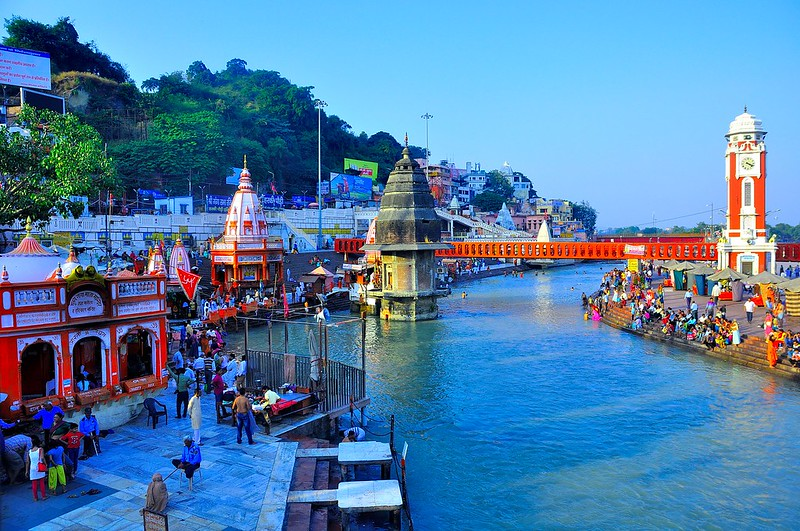
Haridwar is an ancient city and important Hindu pilgrimage site in North India's Uttarakhand state, where the River Ganges exits the Himalayan foothills. The largest of several sacred ghats (bathing steps), Har Ki Pauri hosts a nightly Ganga Aarti (river-worshipping ceremony) in which tiny flickering lamps are floated off the steps. Worshipers fill the city during major festivals including the annual Kanwar Mela.
he city is situated on the right bank of the Ganges river, at the foothills of the Shivalik ranges. Haridwar is regarded as a holy place for Hindus, hosting important religious events and serving as a gateway to several prominent places of worship. Most significant of the events is the Kumbha Mela, which is celebrated every 12 years in Haridwar. During the Haridwar Kumbh Mela, millions of pilgrims, devotees, and tourists congregate in Haridwar to perform ritualistic bathing on the banks of the Ganges to wash away their sins to attain moksha.
In the scriptures, Haridwar has been variously mentioned as Kapilasthana, Gangadwara and Mayapuri. It is also an entry point to the Char Dham (the four main centres of pilgrimage in Uttarakhand viz, Badrinath, Kedarnath, Gangotri, and Yamunotri), hence, Shaivaites (followers of Shiva) and Vaishnavites (followers of Vishnu) call this place Hardwar and Haridwar respectively, corresponding to Hara being Shiv and Hari being Vishnu.
Haridwar came under the rule of the Delhi Sultanate in 1206.
The city also fell to the Central Asian conqueror Timur Lang (1336–1405) on 13 January 1399.
During his visit to Haridwar, first Sikh Guru, Guru Nanak (1469–1539) bathed at 'Kushawart Ghat', wherein the famous, 'watering the crops' episode took place,his visit is today commemorated by a gurudwara (Gurudwara Nanakwara), according to two Sikh Janamsakhis, this visit took place on the Baisakhi day in 1504 CE, he later also visited Kankhal en route to Kotdwara in Garhwal. Pandas of the Haridwar have been known to keep genealogy records of most of the Hindu population. Known as Vahis, these records are updated on each visit to the city, and are a repository of vast family trees of the family in North India.
Leave a Reply