
Kedarnath is a town in Rudraprayag district in the state of Uttarakhand in India and has gained importance because of the Kedarnath Temple. It is approximately 86 kilometres from Rudraprayag, the district headquarter. It is a Nagar panchayat in the Rudraprayag district.
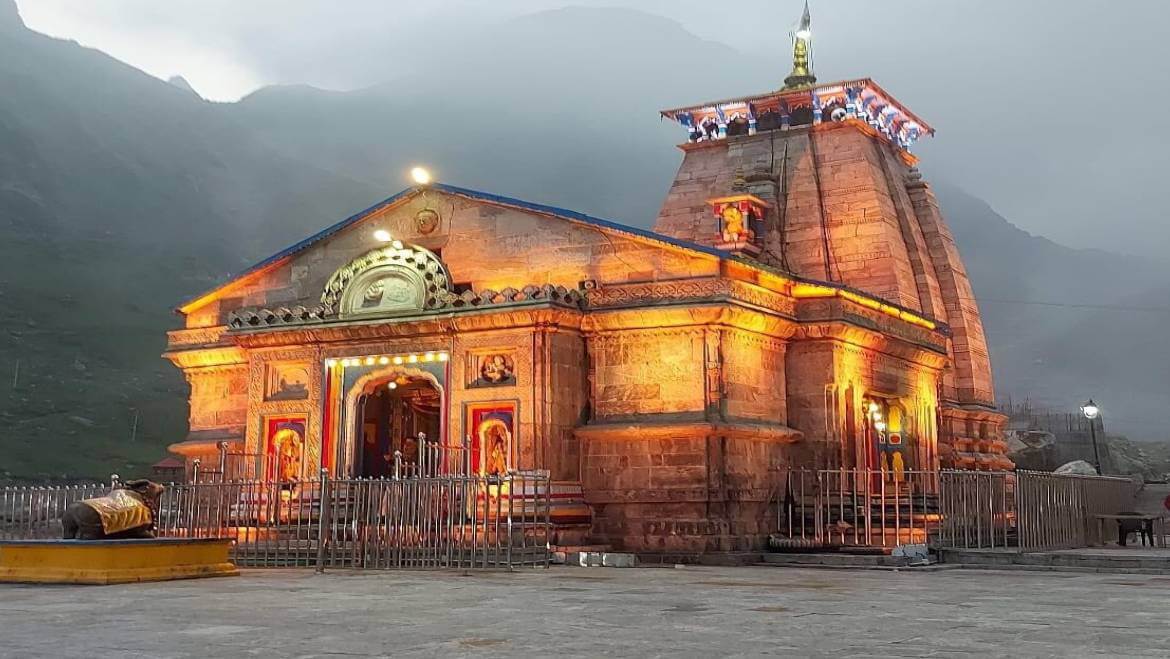
Kedarnath Temple (Sanskrit: केदारनाथ मंदिर, IAST: Kēdāranātha Mandira, lit. 'temple of the God of the field') is a Hindu temple dedicated to Shiva. The temple is located on the Garhwal Himalayan range near the Mandakini river, in the state of Uttarakhand, India. Due to extreme weather conditions, the temple is open to the general public only between the months of April (Akshaya Tritiya) and November (Kartik Purnima, the autumn full moon). During the winters, the vigraha (deity) of the temple is carried down to Ukhimath to be worshipped for the next six months. Kedarnath is seen as a homogenous form of Shiva, the 'Lord of Kedarkhand', the historical name of the region.
The temple, at a height of 3,583 m (11,755 ft), 223 km (139 mi) from Rishikesh, on the shores of Mandakini river, a tributary of Ganga, is a stone edifice of unknown date. It is not certain who built the original Kedarnath temple and when. The name "Kedarnath" means "the lord of the field": it derives from the Sanskrit words kedara ("field") and natha ("lord"). The text Kashi Kedara Mahatmya states that it is so called because "the crop of liberation" grows here.
The Kedarnath valley, along with other parts of the state of Uttarakhand, was hit with unprecedented flash floods on 16 and 17 June 2013. On 16 June, at about 7:30 p.m. a landslide and mudslides occurred near Kedarnath Temple with loud peals of thunder. An enormously loud peal was heard and huge amounts of water started gushing from Chorabari Tal or Gandhi Tal down Mandakini river at about 8:30 p.m. washing everything away in its path. On 17 June 2013 at about 6:40 a.m. waters again started cascading at a huge speed from river Swaraswati and Chorabari Tal or Gandhi Tal bringing along with its flow huge amount of silt, rocks, and boulders. A huge rock got stuck behind Kedarnath Temple and protected it from the ravages of the flood. The waters gushed on both the sides of the temple destroying everything in their path. Even eyewitness observed that one large rock got carried to the rear side of Kedarnath Temple, thus causing obstruction to the debris, diverting the flow of river and debris to the sides of the temple avoiding damage. The rock which protected the temple is worshipped as the God's Rock (भीम शीला).
The presiding image of Kedarnath in the form of lingam is of irregular shape with a pedestal 3.6 m (12 ft) in circumference and 3.6 m (12 ft) in height. There is a small pillared hall in front of the temple, that has images of Parvati and of the five Pandava princes. There are four temples around Kedarnath itself, namely- Tungnath, Rudranath, Madhyamaheshwar and Kalpeshwar which form the Panch Kedar pilgrimage sites. The first hall inside Kedarnath Temple contains statues of the five Pandava brothers, Krishna, Nandi, the vehicle of Shiva and Virabhadra, one of the guards of Shiva. Statues of Draupadi and other deities are also installed in the main hall. An unusual feature of the temple is the head of a man carved in the triangular stone lingam. Such a head is seen carved in another temple nearby constructed on the site where the marriage of Shiva and Parvati was held. Adi Shankara was believed to have revived this temple, along with Badrinath and other temples of Uttarakhand; he is believed to have attained Mahasamadhi at Kedarnath. Behind the temple is the samādhi mandir of Adi Sankara.
Leave a Reply